How Does Memo Matrix Work? It Depends on Your Bottle
Quick answerMemo Matrix has no single mechanism, because three ingredient lists share its name. The full label mixes bacopa, rhodiola, L-theanine, Panax ginseng and BCAAs. A second panel adds caffeine and huperzine A. The sales page lists eight names with no amounts. No study has tested the product itself.
What is Memo Matrix meant to do?
It is sold as a daily capsule for memory and focus. The sales page title reads "Memo Matrix - Official Website," and its headline talks about unleashing your cognitive potential. Those are the seller's words. They are not findings.
Sellers often call this kind of product a nootropic or a cognitive support supplement. Those are marketing terms, not medical ones. They do not tell you that a product works. They only tell you what the seller wants you to think of.
So the useful question is a narrower one. What does each listed ingredient do in the research, and does the amount on your bottle match what was studied? The rest of this post answers that.
Which ingredient list is in your bottle?
Three lists exist, so "how it works" has three answers. The first step is to read the serving size on your own Supplement Facts panel. A serving of two capsules points to the full label. One capsule points to the second panel.
| Item | Full label (REV.11/25) | Second panel image | Sales page list |
|---|---|---|---|
| Serving | 2 capsules, 30 servings | 1 capsule, 30 servings | 2 capsules daily |
| Amounts printed | Yes, for every line | No, the blend hides them | None |
| Core items | BCAAs, bacopa, rhodiola, L-theanine, Panax ginseng | B vitamins and a 151 mg blend with caffeine and huperzine A | Bacopa, ginkgo, lion's mane, phosphatidylserine, rhodiola, alpha-GPC, huperzine A, L-theanine |
We treat the full label as primary because it prints every amount, a distributor and a revision code. Your bottle is still the final word.
How is the full-label capsule built?
It is a short mix of three herbs, one tea amino acid and three branched-chain amino acids. Each has its own printed weight, so nothing hides inside a blend. The five lines add up to 1,030 mg per two-capsule serving.
- BCAAs, 540 mg: leucine, isoleucine and valine in a 2:1:1 ratio. The heaviest line. Studies on mental tiredness used 7 to 10 g during hard exercise (Blomstrand, 2006).
- Bacopa extract, 200 mg: the memory herb. Trials used 300 to 450 mg a day for 12 weeks.
- Rhodiola extract, 100 mg: standardized to 3% salidroside. Studied for tiredness, with mixed results (Ishaque et al., 2012).
- L-theanine, 100 mg: a tea amino acid. Trials mostly gave 200 mg (Gerolymos et al., 2026).
- Panax ginseng extract, 90 mg: a Cochrane review found no convincing thinking benefit in healthy people (Geng et al., 2010 (Cochrane)).
In theory, the plan is a mild mix aimed at focus and tiredness. In practice, several lines sit below the doses researchers used. BCAAs reach about 5 to 8% of the exercise doses. A low dose does not prove failure. It means nobody has tested it.
What does the second panel change?
It works more like a stimulant-and-enzyme formula. The serving is one capsule. It lists vitamins B1, B6 and B12, then a 151 mg proprietary blend of seven items.
The blend names caffeine from green coffee bean, L-tyrosine, theacrine, theobromine, bacopa at 20% bacosides, rhodiola root and a Huperzia serrata extract with 1% huperzine A. No single amount is printed. The most you can say is that each item weighs less than 151 mg.
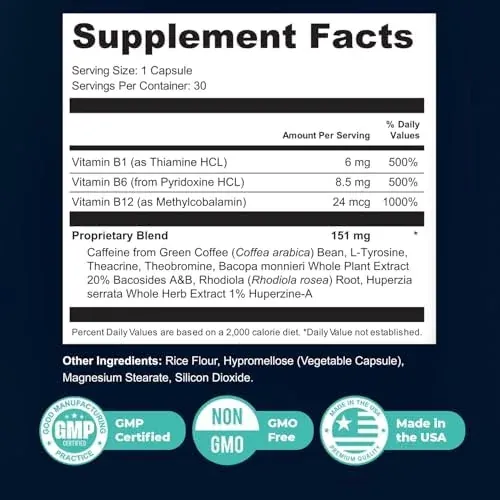
Two items on this panel need a careful read. Caffeine is a stimulant, and the FDA says sensitivity varies a lot from person to person (FDA, How much caffeine is too much?). Huperzine A slows the enzyme that clears acetylcholine, the same enzyme donepezil acts on (MSKCC, Huperzia serrata). If you take a memory medicine, show the bottle to the prescriber first.
What does the sales page list add?
Eight ingredient names sit on the sales page, and none has an amount. Ginkgo, lion's mane, phosphatidylserine and alpha-GPC, four of the eight, show up on neither printed panel. We do not know why the lists differ, and the brand has not said.
A few reasons are possible. Formulas change, and the code REV.11/25 hints that the label has changed before. Sales pages can lag behind bottles. Different sellers may use different copy. None of these can be confirmed from outside.
For ginkgo, a large trial of older adults found no difference in dementia rates over about six years (NCCIH, Ginkgo). For lion's mane, a small pilot trial found no recall benefit (Docherty et al., 2023). Ask your doctor about the rest.
Does it boost blood flow or work instantly?
The sales page says it enhances blood flow to the brain and starts working at once. We found no study for either claim. The FTC asks that health claims in ads rest on solid science (FTC, Health Products Compliance Guidance). We found none for the finished product.
This is why we sort claims into groups: shown, possible and not shown. Bacopa has some human memory trials. Most of the rest of the list is in the "not shown" group, either because the evidence is mixed or because the dose is far from the studied one.
Not a treatment
MemoMatrix is a dietary supplement. It is not FDA approved, and no supplement is. It is no remedy for memory loss, dementia or Alzheimer's disease. NCCIH reports no direct proof that supplements protect against dementia (NCCIH, Supplements for cognitive function).
So how does Memo Matrix actually work?
Nobody can say. No published study of the finished capsule exists in any of its three versions. We can say what each ingredient is studied for, and that is a different thing.
A blend can act differently from its parts. Smaller doses may do less. A stimulant may feel like focus without adding anything to memory. Every one of these points is a reason to hold your expectations loosely.
The practical step is to match your panel, check your medicines with a pharmacist and run a patient 60-day test with notes. Our guide on how long Memo Matrix takes shows how.
What are the key facts on how Memo Matrix works?
- Three ingredient lists share the name. Only bacopa and rhodiola are on all three.
- The full label adds up to 1,030 mg per two-capsule serving, with every amount printed.
- The second panel hides seven items in a 151 mg blend that includes caffeine and huperzine A.
- Bacopa at 200 mg is about two-thirds of the lowest studied dose. L-theanine at 100 mg is half.
- No study of any version has been published.
- MemoMatrix is not FDA approved and is not a treatment for any disease.
Frequently asked questions
How does Memo Matrix work?
It depends on your bottle. The full label is a mix of herbs and amino acids studied for focus and tiredness. A second panel leans on caffeine and huperzine A. No study has tested the product.
Is Memo Matrix a nootropic?
Sellers use that word for products like it. It is a marketing term, not a medical one, and it does not show that the product works.
Does Memo Matrix increase blood flow to the brain?
We found no evidence for that. The sales page makes the claim and gives no study.
What is in the second Memo Matrix panel?
One capsule with vitamins B1, B6 and B12 and a 151 mg blend of caffeine, L-tyrosine, theacrine, theobromine, bacopa, rhodiola and a huperzine A extract. Single amounts are not printed.
Why do the Memo Matrix lists differ?
The brand has not explained it. A revision code on the full label hints that formulas change, and the sales page may describe a different version than your bottle.
Can Memo Matrix replace a memory medicine?
No. It is a dietary supplement, not a treatment for memory loss or dementia. Never stop or swap a prescribed medicine without the prescriber.
Our view
We find the full label the easiest version to understand. Every amount is printed, there is no blend and no caffeine. We also find it the version with the clearest gaps: the amounts sit below the studied doses.
The second panel and the sales list ask for more trust than we can give them, because the amounts are hidden or missing. Our view is simple. Read your bottle, ask your pharmacist and treat the capsule as an optional extra. It is not a plan for your memory.
Last updated . Medically reviewed by Dr. Collin Liu, MD, Physician.