How to Check a Supplement Label, With MemoMatrix as the Worked Example
Quick answerStart with the serving size, then check that each ingredient has its own amount. Blends hide single amounts. A dagger means no Daily Value. Note the revision code and the distributor, and treat badges as marketing. Then compare the bottle with the sales page. For MemoMatrix, three lists circulate, so the panel on your own bottle is the one that counts.
- 60-day satisfaction window
- Free US shipping on 3 and 6 bottles
Why is the Supplement Facts box the place to start?
The Supplement Facts box is the most reliable part of any supplement package. Federal rules set what it must show and how. Ingredients without a Daily Value still need their amount per serving and a symbol that says no Daily Value exists (21 CFR 101.36).
No federal sign-off is needed before a supplement goes on sale (FDA, Q&A on Dietary Supplements). So the label is your main tool. This guide shows seven checks that work on any bottle, then runs them on MemoMatrix.
Step 1: what does the serving size tell you?
Every amount on the panel is per serving, not per capsule. So read the serving size first, then the number of servings per container.
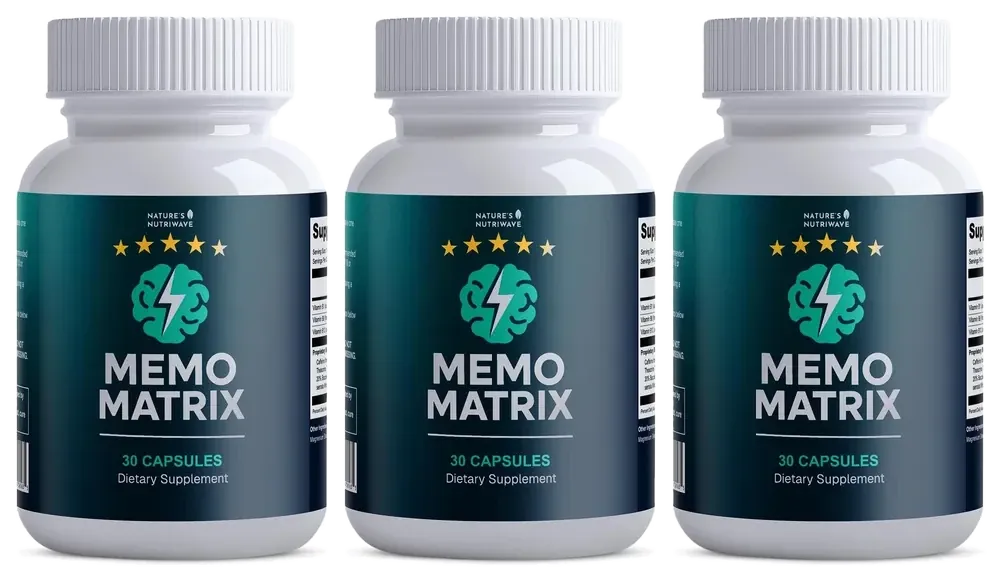
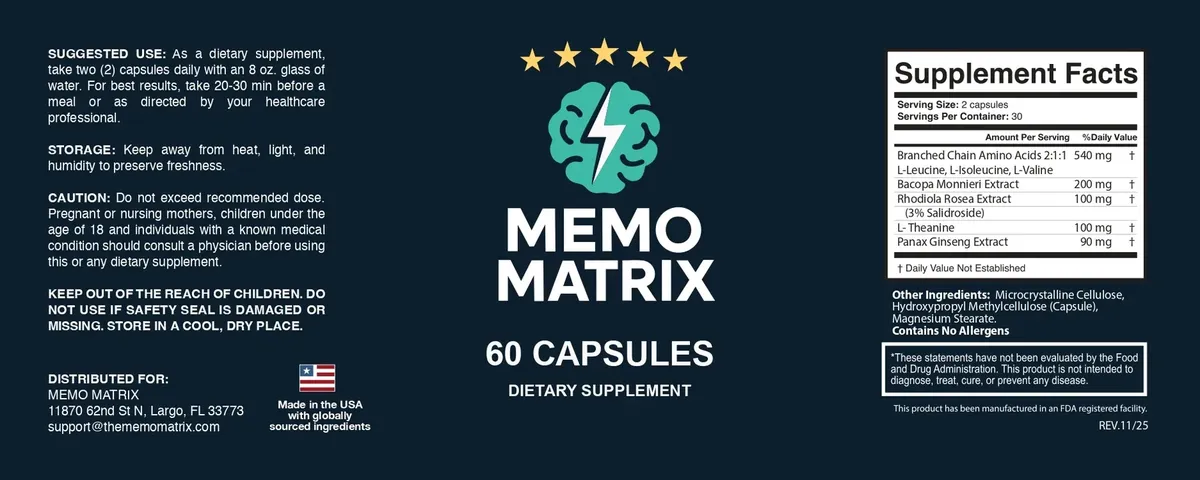
Here is why that matters for MemoMatrix. The full label (REV.11/25) says 2 capsules per serving and 30 servings, or 60 capsules. The second panel says 1 capsule per serving and 30 servings. The bottle photos in the brand pack say 30 capsules on the front.
Each version is meant to last about 30 days. But the daily dose differs, so follow the directions on the bottle you hold.
Step 2: does every ingredient show its own amount?
A clear label prints one amount next to each ingredient. A blend prints one total for a group, and the single amounts stay secret. Blends are legal, but they make it impossible to compare doses with studies.
The full MemoMatrix label prints all five amounts: BCAAs 540 mg, bacopa 200 mg, rhodiola 100 mg, L-theanine 100 mg and Panax ginseng 90 mg. The second panel puts seven ingredients inside one 151 mg blend.
What a 151 mg blend can and cannot tell you
Seven ingredients share 151 mg, so they average about 22 mg each. The real split is unknown. That includes caffeine, so a caffeine-sensitive reader cannot tell how much is inside.
| Second panel line | Amount | %DV |
|---|---|---|
| Vitamin B1 (as Thiamine HCL) | 6 mg | 500% |
| Vitamin B6 (from Pyridoxine HCL) | 8.5 mg | 500% |
| Vitamin B12 (as Methylcobalamin) | 24 mcg | 1000% |
| Proprietary Blend: caffeine from green coffee (Coffea arabica) bean, L-tyrosine, theacrine, theobromine, Bacopa monnieri whole plant extract 20% bacosides A&B, rhodiola (Rhodiola rosea) root, Huperzia serrata whole herb extract 1% huperzine-A | 151 mg | * |
Step 3: what do the dagger and %DV mean?
The dagger (†) next to an amount means no Daily Value exists for that ingredient (21 CFR 101.36). Every line on the full MemoMatrix label carries one, because herbs and amino acids have no set daily target.
A %DV appears only for nutrients with a reference amount, like vitamins. On the second panel, B6 shows 500% and B12 shows 1000%.
Putting big percentages in context
Adults need 2.4 mcg of B12 a day; the second panel lists 24 mcg (NIH ODS, Vitamin B12). Adults need 1.3 to 1.7 mg of B6, and the upper limit is 100 mg (NIH ODS, Vitamin B6). The panel lists 8.5 mg, well under that limit. High percentages are common on vitamin labels and are not a sign of strength or quality.
Step 4: what do revision codes and lot numbers show?
A revision code marks the version of the label. The full MemoMatrix label shows REV.11/25, which likely means November 2025. If a seller shows you a label, compare its code with yours.
A lot number tracks one batch from the factory. The brand pack lists lot MEM-26/ME-3867 and a certificate reference, MEM-3867-26-ME. No certificate itself has been published, so treat both as references only. Our batch page explains what you can and cannot check.
Step 5: who is the product made or distributed for?
Look for the words “Manufactured by”, “Distributed by” or “Distributed for”. The full MemoMatrix label says distributed for Memo Matrix, 11870 62nd St N, Largo, FL 33773. That names the company behind the brand, not the factory.
The label adds “Made in the USA with globally sourced ingredients” and says it was made in an FDA registered facility. Neither line names the factory. A facility listing is not approval of the product.
Step 6: which words are claims, not facts?
Front-label words, star graphics and seals are marketing. The five stars on the MemoMatrix front are design, not a rating. The GMP and FDA badges on brand graphics are not tied to a published certificate, as our testing page explains.
The FTC expects any health promise in an ad to rest on sound scientific proof (FTC, Health Products Compliance Guidance). Any memory claim should come with the FDA statement that it has not been evaluated and that the product is not meant to treat any disease.
Signs of a clear label
- An amount next to every ingredient
- A revision code and a lot number
- A distributor name and street address
- Clear directions and cautions
Signs to slow down
- One total for a group of ingredients
- Seals with no certificate or number behind them
- Promises of fast or certain results
- A sales page list that differs from the bottle
Step 7: how does the MemoMatrix bottle compare with the sales page?
The last step is to put the bottle beside the page you bought from. For MemoMatrix, three lists turn up: the full label, a second panel image and the sales page. Bacopa and rhodiola are the only items on all three.
The sales page names ginkgo, lion's mane, phosphatidylserine and alpha-GPC with no amounts. Neither panel lists them. Huperzine A is on the second panel and the sales page but not on the full label. That matters if you take donepezil-type drugs (MSKCC, Huperzia serrata); read the huperzine A page before your first dose.
| Ingredient | Full label (REV.11/25) | Second panel image | Sales page |
|---|---|---|---|
| Bacopa monnieri | 200 mg extract | In a 151 mg blend (20% bacosides) | Listed, no amount |
| Rhodiola rosea | 100 mg extract (3% salidroside) | In the blend (root) | Listed, no amount |
| L-Theanine | 100 mg | Not listed | Listed, no amount |
| Panax ginseng | 90 mg | Not listed | Not listed |
| BCAAs (leucine, isoleucine, valine) | 540 mg | Not listed | Not listed |
| Huperzine A (Huperzia serrata) | Not listed | In the blend (1% huperzine-A extract) | Listed, no amount |
| Caffeine, theacrine, theobromine, L-tyrosine | Not listed | In the blend | Not listed |
| Vitamins B1, B6, B12 | Not listed | 6 mg, 8.5 mg, 24 mcg | Not listed |
| Ginkgo biloba, lion's mane, phosphatidylserine, alpha-GPC | Not listed | Not listed | Listed, no amount |
| Serving | 2 capsules, 30 servings (60 capsules) | 1 capsule, 30 servings | 2 capsules daily |
Honest note
On the full label, bacopa is 200 mg against the 300 to 450 mg used in recall trials (Pase et al., 2012), and L-theanine is 100 mg against the 200 mg most studies used (Gerolymos et al., 2026). Nobody has published a trial of the MemoMatrix capsules as sold.
What should you do if the lists do not match?
Steps for a bottle that differs from the lists
- Photograph the Supplement Facts panel and the lot number on your bottle.
- Match it against the three lists on the formula page.
- Call the order desk at +1 (919) 991-9391 with your order ID and ask which formula was shipped.
- Show the photo to your pharmacist before the first dose, especially if huperzine A or caffeine is listed.
- Keep the order email; the 60-day money-back window runs from the order date.
Supplement label FAQ
How do you read a supplement label?
Start with the serving size, then read the amount next to each ingredient. Check for blends, symbols, the warnings, and who the product is distributed for.
What does proprietary blend mean on a supplement?
It means several ingredients share one total weight, and the single amounts are not printed. You cannot tell how much of each one you get.
Why is there a little cross (†) beside some supplement amounts?
That mark flags an ingredient with no Daily Value on record. Herbs and amino acids usually carry it.
What does % Daily Value mean on a supplement?
It compares the amount in one serving with a reference amount for a day. A figure of 500% means five times that reference amount.
Why does my supplement bottle not match the website?
Formulas change, and sales pages are not always updated. Go by the panel on your bottle and ask the seller which version you were sent.
Does an FDA registered facility mean the product has FDA approval?
No. A facility listing is not approval of the product, and the agency has no power to clear a supplement for sale in advance.
What does distributed for mean on a supplement label?
It names the company that markets the product, which may not be the factory that made it. The maker is often not named.
What is the REV code on a supplement label?
It is a label revision code. REV.11/25 on the full MemoMatrix label likely marks a November 2025 version.
Where can I check if a supplement is safe with my medicines?
Ask your pharmacist or doctor and bring the bottle. Federal fact sheets from NIH and NCCIH also list known interactions for single ingredients.
Label checked? Compare MemoMatrix packs next
Two capsules a day by the full label, from $49 a bottle on 6 bottles, with a 60-day money-back guarantee on the sales page. Three ingredient lists circulate, so compare the panel on your bottle with this site before your first dose.