How Does MemoMatrix Work? The Ingredients Behind Each Capsule
Quick answerMemoMatrix is meant to work through its ingredients, and which ones you get depends on the panel on your bottle.
The full label pairs bacopa, rhodiola, L-theanine, Panax ginseng and BCAAs, each studied for focus or tiredness. A second panel adds caffeine, a stimulant, and huperzine A, which acts on a memory-related enzyme.
Next, see how to take MemoMatrix for your panel.
- 60-day satisfaction window
- Free US shipping on 3 and 6 bottles
What is MemoMatrix meant to do?
MemoMatrix is sold as a daily capsule for memory and focus. How it is meant to do that depends on which ingredient list you go by. Three different lists circulate under the same name.
So this page does not tell one story. It walks through each version and what its ingredients have been studied for. Then it explains why the version in your bottle is the only one that matters.
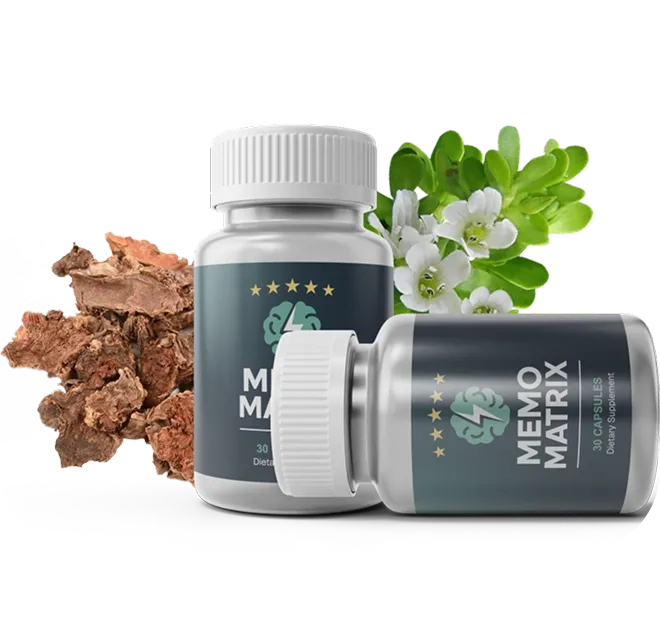
The photo is a brand image of two bottles with dried roots and flowers. The plants are styling, not a list of contents.
Three versions of MemoMatrix, side by side
The three lists share only two ingredients: bacopa and rhodiola. Everything else changes from list to list. This site treats the full label as primary, because it prints every amount, a distributor and a revision code.
| Ingredient | Full label (REV.11/25) | Second panel image | Sales page |
|---|---|---|---|
| Bacopa monnieri | 200 mg extract | In a 151 mg blend (20% bacosides) | Listed, no amount |
| Rhodiola rosea | 100 mg extract (3% salidroside) | In the blend (root) | Listed, no amount |
| L-Theanine | 100 mg | Not listed | Listed, no amount |
| Panax ginseng | 90 mg | Not listed | Not listed |
| BCAAs (leucine, isoleucine, valine) | 540 mg | Not listed | Not listed |
| Huperzine A (Huperzia serrata) | Not listed | In the blend (1% huperzine-A extract) | Listed, no amount |
| Caffeine, theacrine, theobromine, L-tyrosine | Not listed | In the blend | Not listed |
| Vitamins B1, B6, B12 | Not listed | 6 mg, 8.5 mg, 24 mcg | Not listed |
| Ginkgo biloba, lion's mane, phosphatidylserine, alpha-GPC | Not listed | Not listed | Listed, no amount |
| Serving | 2 capsules, 30 servings (60 capsules) | 1 capsule, 30 servings | 2 capsules daily |
Our which formula is it page shows both label images and explains how to match yours.
How is the full label built?
The full label is a mix of three herbs, one tea amino acid and a group of three amino acids. Every line has its own printed amount, which adds up to 1,030 mg per 2-capsule serving. The bar below shows each line by weight.
- Branched Chain Amino Acids 540 mg
- Bacopa Monnieri Extract 200 mg
- Rhodiola Rosea Extract 100 mg
- L-Theanine 100 mg
- Panax Ginseng Extract 90 mg
| Ingredient | Full label | What it is studied for | What research found | Source |
|---|---|---|---|---|
| BCAAs | 540 mg | Mental tiredness during hard exercise | Used 7-10 g; no memory trials in resting adults | (Blomstrand, 2006) |
| Bacopa monnieri | 200 mg | Memory and attention over months | Some free-recall gains at 300-450 mg a day for 12 weeks | (Pase et al., 2012) |
| Rhodiola rosea | 100 mg | Physical and mental tiredness | Contradictory trials with high risk of bias | (Ishaque et al., 2012) |
| L-theanine | 100 mg | Calm focus and reaction time | Faster reactions after one 200 mg serving in pooled trials | (Gerolymos et al., 2026) |
| Panax ginseng | 90 mg | Thinking and mental fatigue | No convincing benefit in healthy people | (Geng et al., 2010 (Cochrane)) |
What do the full-label ingredients add up to?
On paper, the idea is a gentle mix for focus and tiredness. Bacopa is the memory herb, studied over 12 weeks or more. L-theanine is linked to calm focus. Rhodiola and ginseng are sold for mental fatigue. BCAAs are the heaviest line, but their studies are about exercise.
Several of these lines fall short of what researchers gave volunteers. The bacopa line reaches roughly 67% of a 300 mg trial dose, and theanine reaches 50% of 200 mg. Falling short does not prove the capsule fails. We simply have no trial data for those smaller amounts.
Each line has its own section on our ingredients page, with side effects and medicine cautions.
- 5lines on the full label
- 1,030 mgtotal per 2 capsules
- 2 of 5lines also on all three lists
What does the second panel's blend add?
The second panel works more like a stimulant and enzyme formula. It is 1 capsule a day with B vitamins and a 151 mg proprietary blend. The blend lists seven ingredients with no single amounts.
Caffeine from green coffee
A stimulant that can make you feel more alert. The amount is not printed. The FDA says up to 400 mg a day is not usually linked to danger in healthy adults, but sensitivity varies (FDA, How much caffeine is too much?).
Huperzine A
Blocks acetylcholinesterase, the enzyme that clears a nerve messenger. Donepezil works on the same enzyme (MedlinePlus, Donepezil). Read the huperzine A page before you combine it with any medicine.
Theacrine, theobromine, L-tyrosine
Listed by name only, with no amounts. We have not reviewed sources on them, so we make no claim about what they do here.
B1, B6 and B12
Printed at 500% to 1000% of the Daily Value. Adults need 2.4 mcg of B12 (NIH ODS, Vitamin B12) and 1.3-1.7 mg of B6, with a 100 mg upper limit (NIH ODS, Vitamin B6).
Bacopa and rhodiola are also in the blend, at amounts nobody can see. If your panel lists caffeine, read our caffeine section. A capsule that feels energizing may simply be the caffeine at work.
Why does the sales page list something else?
We do not know, and the brand has not said. The sales page names eight ingredients with no amounts. Four of them, ginkgo, lion’s mane, phosphatidylserine and alpha-GPC, appear on neither printed panel.
A few explanations are possible. Formulas change, and the revision code REV.11/25 suggests the label has changed before. Sales pages can lag behind bottles. Different sellers may also use different copy. None of these can be confirmed from the outside.
The sales page also makes claims we do not repeat as fact. It says the capsule improves memory, enhances blood flow to the brain and starts working right away. FTC guidance asks for solid scientific backing behind health claims in ads (FTC, Health Products Compliance Guidance). We found none for the product itself.
Has anyone studied MemoMatrix itself?
Honest note: no. We found no published study of MemoMatrix in any version. Everything on this page is about single ingredients, often tested at higher doses and in different groups of people.
Supplements do not pass any FDA approval step before they hit the market (FDA, Q&A on Dietary Supplements). An NIH center adds that no supplement has direct proof of preventing dementia (NCCIH, Supplements for cognitive function). So any promise of a set result by a set date is not backed by research.
Why matching your bottle matters before the first dose
The version you hold changes the dose, the serving size and the safety checks. The full label says 2 capsules a day. The second panel says 1 capsule. Only the second panel lists caffeine and huperzine A. These four steps keep it simple.
When to skip the supplement and get help
Memory loss that disrupts daily life needs a doctor, not a supplement. If speech, thinking or strength on one side changes in an instant, assume a stroke and dial 911. See the NIA (NIA, Memory problems and aging) and CDC (CDC, Stroke signs) for the signs.
How MemoMatrix works: questions people search
What is MemoMatrix supposed to do inside the body?
It depends on your bottle's panel. The full label is a mix of herbs and amino acids studied for focus and tiredness, while a second panel relies more on caffeine and huperzine A. No study has tested the product.
Does MemoMatrix start working right away?
No study shows that. The sales page says it starts working immediately, but that claim has not been tested, and the caffeine version may simply feel stimulating.
Is there caffeine in MemoMatrix?
Only in one version. The second Supplement Facts panel lists caffeine from green coffee bean inside a 151 mg blend, with no amount printed. The full label lists no caffeine.
Why would one product carry three formulas?
The brand has not explained it. A label revision code, REV.11/25, hints that formulas change, and the sales page may describe a different version than your bottle.
Is the MemoMatrix blood-flow claim backed by a study?
That is a sales page claim we could not verify. No study of the product has measured blood flow.
Has MemoMatrix been clinically tested?
No published study has tested any version of it. The research we cite is on single ingredients, often at higher doses.
Which MemoMatrix ingredient is there the most of?
On the full label, the largest line is BCAAs at 540 mg, followed by bacopa at 200 mg. Bacopa and rhodiola are the only ingredients on all three lists.
Could MemoMatrix stand in for a prescribed dementia drug?
No. It is a dietary supplement, not a treatment for memory loss or dementia, and one version contains huperzine A, which can stack with donepezil-type drugs.
What does a proprietary blend mean on a label?
It is a group of ingredients listed under one total weight, without each amount. On the second panel the blend weighs 151 mg and holds seven ingredients.
Matched your formula? See the MemoMatrix order options
Two capsules a day by the full label, from $49 a bottle on 6 bottles, with a 60-day money-back guarantee on the sales page. Three ingredient lists circulate, so compare the panel on your bottle with this site before your first dose.