Does Memo Matrix Help You Focus? What the Label Can and Cannot Promise
Quick answerNobody has shown that Memo Matrix helps you focus, because no study of the product exists. Two of its ingredients have research that fits focus, L-theanine and bacopa, but the full label lists less of each than the studies used. A second panel adds caffeine with no amount printed. Sleep and a medicine check come first.
What does Memo Matrix promise about focus?
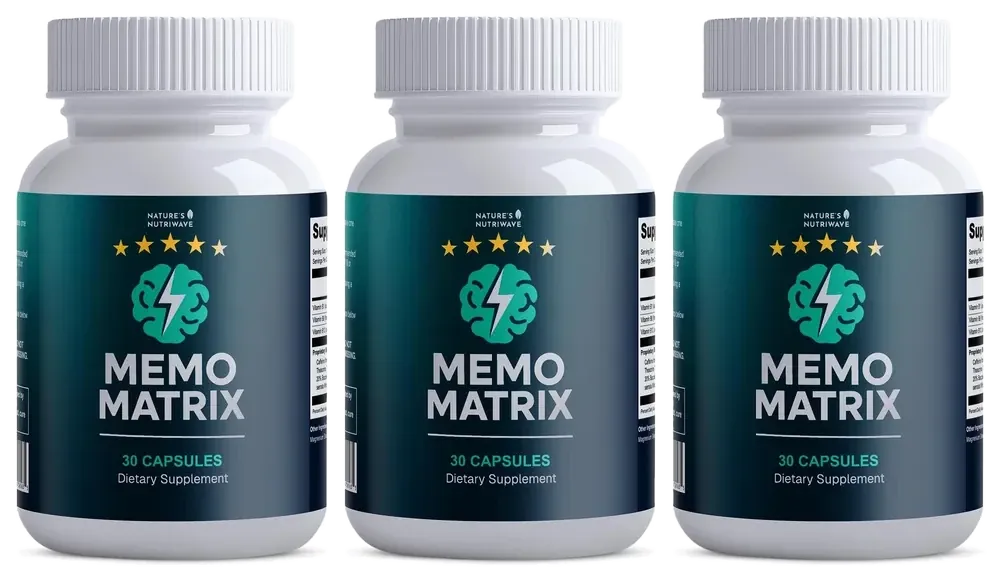
The bottle promises nothing about focus. The front of the full label shows a name, five stars, a count and the words Dietary Supplement. The words about the mind live on the sales page.
There the headline talks about unleashing cognitive potential. A second line promises to boost mental clarity and make you feel amazing. The sales page also says the product improves memory and cognition and starts working immediately, even while you sleep.
None of those lines comes with a study. Bacopa trials measured change after 12 weeks, not overnight (Pase et al., 2012). So we treat the sales lines as the seller's hopes, not as results.
Not FDA approved
MemoMatrix is a dietary supplement. The FDA approves no dietary supplement, and this product is not intended to diagnose, treat, cure or prevent any disease. If focus has dropped, see a doctor before you try a capsule.
Which ingredients have research that fits focus?
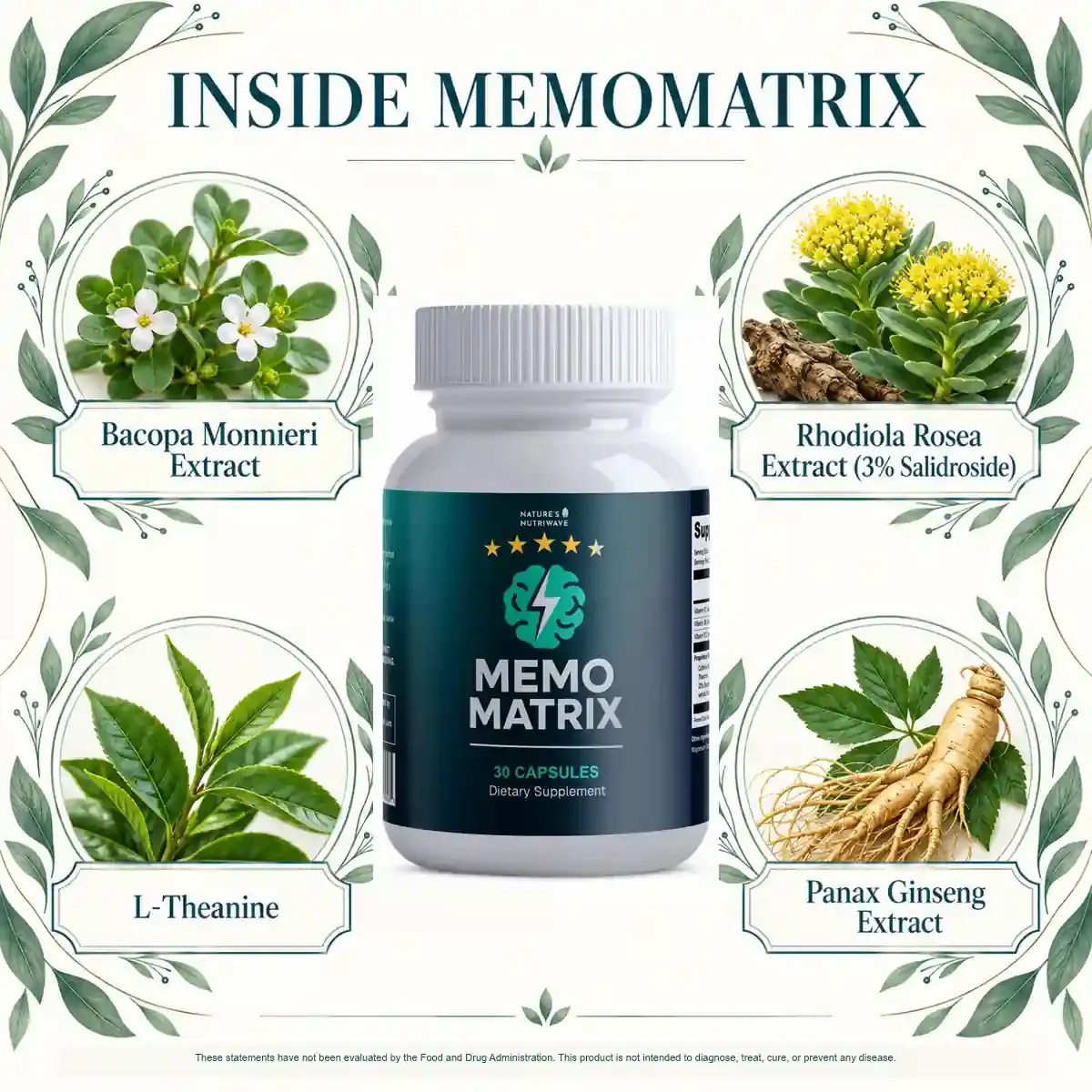
Two do, in a limited way. L-theanine is an amino acid that occurs in tea leaves. A review of 31 randomized trials found a faster reaction time after a single 200 mg dose (Gerolymos et al., 2026). Bacopa is a herb. A review of 9 trials with 518 people, each lasting at least 12 weeks, found faster speed of attention (Kongkeaw et al., 2014).
Those are small, specific results. Reaction time and attention speed are lab tasks. They are not the same as staying on a report for an afternoon.
| Ingredient | On which list | Full-label amount | What was studied |
|---|---|---|---|
| L-theanine | Full label and sales page | 100 mg | Faster reaction time after one 200 mg dose |
| Bacopa monnieri | All three lists | 200 mg | Faster attention over 12 weeks or more, at 300 to 450 mg a day |
| Caffeine blend | Second panel only | Not printed | Stimulant alertness, which is not a memory result |
| Rhodiola | All three lists | 100 mg | Mixed results for tiredness, high risk of bias |
| BCAAs | Full label | 540 mg | Mental tiredness during hard exercise, at 7 to 10 g |
Do the label doses match the doses in the studies?
Mostly they sit below. The theanine line is half of the 200 mg that most studies used. The bacopa line is about two-thirds of the lowest studied dose of 300 mg. The BCAA line is roughly 5 to 8 percent of the amounts used in exercise studies (Blomstrand, 2006).
A lower dose is not proof of failure. It simply means the research does not speak to that amount. A label that sits near the tested dose lets you lean on the studies a little. A label far below lets you lean on them very little.
The ginseng line, at 90 mg, is under half of the 200 mg that a lab study gave as a single dose (Reay et al., 2005). A Cochrane review found no convincing thinking benefit from ginseng in healthy people (Geng et al., 2010 (Cochrane)).
What about the alertness from the one-capsule panel?
The second panel is different. Its 151 mg blend holds caffeine from green coffee bean, L-tyrosine, theacrine and theobromine. Caffeine and its relatives can make you feel more awake for a few hours.
That feeling is real, but it is a stimulant effect. It does not mean better recall. The amount of caffeine in the blend is not printed, so you cannot count it against your coffee.
For healthy adults, 400 mg of caffeine a day is not generally linked to dangerous effects, and sensitivity varies (FDA, How much caffeine is too much?). If your panel lists caffeine, keep your coffee steady and take the capsule early in the day. Our caffeine article covers the counting.
Do focus supplements work in general?
The honest summary is that some single ingredients show small gains on narrow tests, and the finished blends are rarely studied. That is true here. No trial of Memo Matrix has been published, so every number above comes from single-ingredient research.
A blend can behave differently from its parts. Smaller doses can do less. And three ingredient lists share the name, so a study of one ingredient only fits the bottle that holds it.
NCCIH finds no direct proof that any supplement protects against dementia (NCCIH, Supplements for cognitive function). That is a different question from focus, but it shows how far the evidence reaches.
What can sharpen focus more than a capsule?
Dull focus often has plain causes. Short or broken sleep makes attention harder the next day. Untreated hearing loss makes every conversation more tiring. A medicine can also be the cause, since some sleep aids, allergy pills and bladder, mood or pain medicines are known to dull thinking.
- Keep a fixed wake-up time, even on weekends.
- Move after a meal; a short walk counts.
- Book a hearing test and a blood pressure check.
- Ask a pharmacist to review every pill, herb and supplement you take.
- Keep caffeine to the morning and early afternoon.
Our habits guide gives each of these in more detail.
Who should check with a doctor before trying it?
The label names pregnant or nursing mothers, anyone under 18 and anyone with a known medical condition. We would add people who take a memory medicine, a blood thinner, an antidepressant, blood pressure medicine or diabetes medicine.
Huperzine A, found on the second panel and the sales page list, acts on the same enzyme as donepezil (MSKCC, Huperzia serrata). If you take donepezil or a similar drug, show the bottle to the prescriber first.
Focus trouble that is new, sudden or growing is a reason to see a doctor. A confused or slurred moment that comes on fast can be a stroke. Call 911 (CDC, Stroke signs).
How can you test your own focus fairly over 60 days?
- Write a short baseline before the first dose: sleep, the task you want to do better and how often you lose your place.
- Keep coffee, sleep time and exercise as steady as you can.
- Add three lines of notes once a week, at the same time.
- Compare week 4 with your baseline and decide on about day 45.
- If a side effect is strong or lingers, stop and call a doctor.
The guarantee runs 60 days from the order date, and the buyer pays return shipping. Ask the order desk which return rule applies to you before you mail anything. A pack with 6 bottles lasts about 180 days, far past the window, so you will hold unused bottles when it closes.
What are the key facts on Memo Matrix and focus?
- No published study of Memo Matrix tests focus.
- L-theanine on the full label is 100 mg; the studies we cite used 200 mg.
- Bacopa on the full label is 200 mg; the trials used 300 to 450 mg a day for 12 weeks.
- The second panel lists caffeine inside a 151 mg blend with no amount printed.
- The sales page claims, such as starts working immediately, come with no study.
- Sleep, hearing, blood pressure and a medicine review come before any capsule.
Frequently asked questions
Does Memo Matrix help you focus?
That has not been shown. No study of the product exists, and its full label lists less L-theanine and bacopa than the studies used.
Which Memo Matrix ingredient is best for focus?
L-theanine and bacopa have the research that fits best, but only at higher doses than the full label gives. Neither result comes from a study of Memo Matrix.
Do focus supplements work?
Some single ingredients show small gains on narrow tests. Finished blends are rarely studied, so a result for one ingredient does not prove a bottle works.
Does Memo Matrix have caffeine?
The full label lists none. The second panel lists caffeine inside a 151 mg blend, with no amount printed.
What are the side effects to watch for?
Reported effects include stomach upset from bacopa, poor sleep from stimulants and ginseng, and dizziness. Stop and call a doctor if a side effect is strong.
Is Memo Matrix meant for adults only?
The label asks anyone under 18 to consult a physician first. It is sold to adults, and the brand pack says adults 18 and older.
Our view
We would not buy this capsule for focus alone. The research behind two of its ingredients is real but small, and the doses on the full label sit below what the studies gave. The second panel adds a stimulant whose size nobody can read.
If your focus has slipped, start with the cheap, dull things: sleep, a hearing test, a medicine review. If you still want to try the capsule, treat it as a 60-day experiment with notes and a decision date.
Last updated . Medically reviewed by Dr. Collin Liu, MD, Physician.